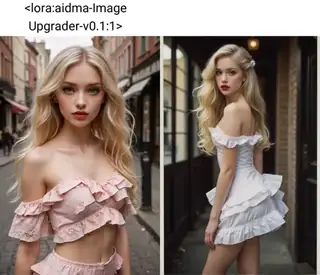
Kate bock ti

Best for beginners. Describe what you want in a chat and the picture comes back, no learning curve.

Images and video from a chat, with short commands. The most convenient tool for Telegram users, with a web companion.

Best for power users. Full control over models, settings and workflows in a browser studio.

Best for communities. Add it to your own server and run any workflow from a channel.

One screen for every model and workflow: prompts, references, edits and video, built into your Graydient account.

Generate on Civitai's own site; every image is paid for with Buzz credits.

Set up local programs if your computer has capable hardware.

Generate the same prompt on up to 50 checkpoint/base models at a time.

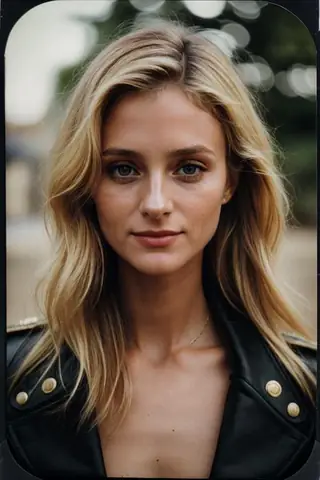
__html__Kate Bock is a Canadian model, mostly known for her appearances in the the Sports Illustrated magazine, for which she was the cover girl in 2020.This is a 135-step TI trained on a dataset of 15 images with these settings.Curious about my work process? I have summarized it here.Do you have a specific idea for a TI in mind? Visit my website and let me know.Building a good prompt with my TIsYou're obviously free to experiment, but bear in mind that my TIs are trained with a more or less fixed phrasing, that normally starts with:"photo of EMBEDDING_NAME, a woman"So I recommend always…__html__Kate Bock is a Canadian model, mostly known for her appearances in the the Sports Illustrated magazine, for which she was the cover girl in 2020.This is a 135-step TI trained on a dataset of 15 images with these settings.Curious about my work process? I have summarized it here.Do you have a specific idea for a TI in mind? Visit my website and let me know.Building a good prompt with my TIsYou're obviously free to experiment, but bear in mind that my TIs are trained with a more or less fixed phrasing, that normally starts with:"photo of EMBEDDING_NAME, a woman"So I recommend always starting your prompt like that and then building the rest of the prompt from there. For instance, "photo of beautiful (kb0ckv11:0.99), a woman with perfect hair, wearing Golden Yellow (cassock:1.1), (cosmic background:1.1), (closeup), modelshoot style, (extremely detailed CG unity 8k wallpaper), professional majestic photography, (Leica M6 Camera), 24mm, exposure blend, hdr, faded, extremely intricate, High (Detail:1.1), Sharp focus, dramatic, soft cinematic light, (looking at viewer), (detailed pupils), 4k textures, elegant, ((((cinematic look)))), soothing tones, insane details, hyperdetailed, low contrast".Please also note that I'm using the "add detail" LoRA for my example pics. I recommend setting it around 0.5 for best results.

Glossary: the terms used here
- Heat score
- One number for how much a model is used and wanted right now, from 0° to 9,999°. Every list on this site that says hottest is sorted by it and nothing else.
- Floor
- The 7,000° every model with real data starts from. The scale runs from 0° to 9,999°; the part below the floor is reserved for stand-ins (models without data), so that a model with data always ranks above one without. The floor is the same for everyone and decides nothing; the degrees above it are the measurement.
- Download-equivalents
- Everything the score treats as a download, added up: downloads themselves, each torrent seeder as 1,000, each AI Horde image and each run on a generation site as one.
- Log scale
- Counting by tens, not by ones: going from 1,000 to 10,000 downloads adds the same degrees as going from 10,000 to 100,000. It keeps giants from crowding out everything else.
- Likes
- Thumbs up and likes from every source, worth half a download each on the log scale.
- Adoption rate
- How many downloads a day a model gets right now, from the difference between two readings of a source. A quarter of the weight of the download term.
- Measured and estimated
- Measured means two readings of a source exist and the difference is real. Estimated means only today's total is known and the past is spread over the model's life; the site says which one it is showing.
- Seeder
- Someone who keeps a copy of the weights online for others to download over a torrent, or a hosted mirror doing the same. Each one counts as 1,000 downloads.
- AI Horde
- A volunteer network that generates images for free on donated computers. The number of images it has made with a model is public, and each counts as one download.
- Generation sites
- Sites that host their own copies of a model and let people generate with it, such as PixAI, SeaArt and Yodayo. Their downloads count like Civitai's and each generation run as one download.
- OpenRouter tokens
- A text model served through an API, such as Claude or GPT, has no weights to download, so its usage is measured in tokens: the pieces of text it read and wrote through OpenRouter, a gateway many apps use, over the last 30 days. Every 10,000,000 tokens count as one download. Source: OpenRouter (openrouter.ai/rankings), CC BY 4.0.
- Full model (checkpoint)
- The weights themselves, the file that generates on its own. It gets a bonus because add-ons depend on it.
- LoRA and embedding
- Small add-on files that steer someone else's weights toward a style, a character or a concept. They cannot run alone.
- Family and weights
- The base a model is built on, such as SD 1.5, SDXL, Flux or Wan. Every model inherits the release date of its family's weights.
- Age
- Degrees taken off for how long ago the family's weights came out: 150° a year, up to 750°. It keeps old downloads that had years to pile up from freezing the top of the list.
- Family boost
- A small, bounded nudge for LoRAs of a family this site is pushing forward right now, always listed in the breakdown.
- Stand-in score
- A stable number below the floor given to a model no source reports on yet, so lists stay complete. It never ranks above a model with data.
- New! (grace period)
- A model less than 7 days old shows New! instead of a score and holds no place in the rankings. Its score is computed from day one, but a model one day old grows faster than anything, so without the wait the week's #1 would always be whatever came out yesterday rather than what held up for a week.
- Trend
- How a model's growth over a period compares with the typical model's growth over the same period. Faster than typical reads as a rise, slower as a fall.
- Typical model
- The middle of the catalog: half the models with a figure grew faster over the period, half slower.