
Extreme Enduro Better Bike POVs and Motion
8076°
<extreme-enduro-h3>
Aplicațiile care suportă etichetele ModelTrends îți permit să rulezi/instalezi modele copind acest cod în promptul tău, fără configurare. Caută pictograma noastră în aplicațiile care o suportă, cum este Prism (mai jos).
Rulează modelul
Oferte / Reclame

Easy Creator (Prism) Web
Nelimitat · taxă fixă
Cel mai bun pentru începători. Fluxuri de lucru puternice, curbă de învățare redusă.

PirateDiffusion Telegram
Nelimitat · taxă fixă
Creează videoclipuri, imagini, personaje personalizate pentru chat și altele.

Pro studio (SpyGlass) Web
Nelimitat · taxă fixă
Răsfoiește modele, redă și rafinează de pe orice browser sau telefon.

Discord bot (Vector)
Nelimitat · taxă fixă
Adaugă Vector pe serverul tău sau alătură-te Discord-ului Vector. Creează orice!

Unified Editor Web
Nelimitat · taxă fixă
Editor pentru imagini și video: redă, editează, mărește și altele pe o singură pagină.

Civitai Web
Plătești pe utilizare
Generează pe site-ul Civitai; fiecare imagine se plătește cu credite Buzz.

Aplicații locale
Necesită configurare
Instalează programe locale dacă ai hardware potrivit pe calculator.

ModelDuel Web
Plătești pe utilizare
Generează același prompt pe până la 50 de modele checkpoint/base simultan.


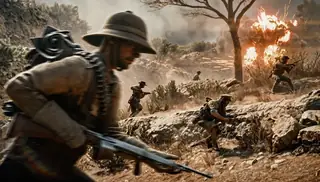
By - Nottheninja Presenting my first well trained H3 LoRA. This can be used for any sort of POV bike motion generations that you plan on, specifically tested with fast paced enduro races. H3 by default creates slow motion, janky physics when prompted for the same without this LoRA. You can also try it out on a wider variety of usecases, as it tends to improve the motion and physics for general bike POVs, actions scenes, and stunt POVs too. Use it at strengths around 0.8 to 1.
Notele creatorului
Presenting my first well trained H3 LoRA. This can be used for any sort of POV bike motion generations that you plan on, specifically tested with fast paced enduro races.
H3 by default creates slow motion, janky physics when prompted for the same without this LoRA. You can also try it out on a wider variety of usecases, as it tends to improve the motion and physics for general bike POVs, actions scenes, and stunt POVs too.
Use it at strengths around 0.8 to 1.
The showcase videos are generated on my RTX 3060 and workflows should be embedded in the videos.
If you want to support the creation of more models like this, or you just like what you see (I could REALLY use it):
SHA256
B47F9B0640679690D7466B8DEBD6D9392A250BAB77EF575000A14A43276597E3
Ranking badge
Updated Oct 22, 2026

Made this model? Show this badge on your page.
Paste it into your Hugging Face card or Civitai description.
Also ranked: #85 Hottest MiniMax H3 LoRA
Not this creator?
Get your own badge
Tendința de popularitate a Extreme Enduro Better Bike POVs and Motion
Scor de căldură din 8 Oct 2026
Scor de popularitate
8,076°
Săptămâna aceasta
n/a
Nu a fost lansat/urmărit
Luna aceasta
n/a
Nu a fost lansat/urmărit
Ultimul an
n/a
Nu a fost lansat/urmărit
7,000°
Prag minim
Scara merge de la 0° la 9.999°. Tot ce este sub 7,000° este rezervat pentru modelele despre care nicio sursă nu raportează încă, care au un număr provizoriu acolo ca să rămână listele complete. 7,000° este punctul de start pentru datele măsurate: un model cu date reale, dar aproape fără descărcări, stă la prag, iar măsurătorile umplu gradele de deasupra. Pragul nu spune nimic despre model; doar gradele de deasupra îl diferențiază de alte modele.
+752°
Descărcări Civitai
320 descărcări ale acestei versiuni exacte pe Civitai. Descărcările sunt ingredientul cel mai important și sunt numărate pe o scară logaritmică: de zece ori mai multe descărcări adaugă același 300°, deci un model cu un milion de descărcări nu este de o mie de ori mai popular decât unul cu o mie. Cele șase surse de descărcări împart acest termen, proporțional cu numărul lor.
+224°
Apăsări de like
30 like-uri și aprecieri pe toate sursele. Un like valorează jumătate de descărcare, pe aceeași scară logaritmică.
+100°
Boost familie
+100° pentru că este un LoRA dintr-o familie pe care site-ul o promovează acum. Este un impuls limitat în scor și este listat deschis aici; nu poate ascunde un model sau depăși o diferență de o mie de ori în descărcări.
Arată detalii
Fiecare număr de pe acest site poate fi verificat. Scorul de popularitate al acestui model este 8,076°, iar aici este construit pas cu pas, cu totalul acumulat după fiecare ingredient: pragul minim, gradele adăugate de fiecare sursă, bonusul pentru tipul modelului și ce scade vârsta greutăților. Culorile sunt benzile din graficul de mai sus. Glosarul de la final definește fiecare termen.
- 1Începe de la prag.De ce 7,000° și nu zero: scara merge de la 0° la 9.999°, iar partea de sub 7,000° este rezervată modelelor despre care nicio sursă nu raportează încă, care au un număr provizoriu acolo ca să rămână listele complete și să nu depășească niciodată un model cu date. 7,000° este punctul de start pentru datele măsurate. Un model cu date reale, dar aproape fără descărcări, stă aici; tot ce urmează este măsurare, iar spațiul de deasupra pragului conține zece pași de zece ori mai multe descărcări, fiecare la 300°. Pragul este același pentru toate modelele, deci nu decide nimic; gradele de deasupra fac diferența.7,000°total curent
- 2Adaugă descărcările.320 echivalente de descărcări în total, de la Descărcări Civitai. De zece ori descărcările adaugă același 300°, deci mărimea contează, dar nu domină scorul.+752°7,752°total curent
- 3Adaugă aprecierile.30 aprecieri și like-uri, la jumătate din greutatea unei descărcări.+224°7,976°total curent
- 4Boost de familie.Un impuls deschis și limitat pentru LoRA-urile dintr-o familie pe care site-ul o promovează acum.+100°8,076°total curent
- =Scorul de căldură.Unde se situează acest model pe fiecare listă de pe site. Nimic altceva nu îl ajustează.8,076°
Glosar: termenii folosiți aici
- Scor de căldură
- Un număr care arată cât de mult este folosit și dorit un model acum, de la 0° la 9.999°. Fiecare listă de pe site care spune „cele mai călduroase” este sortată după acest scor și nimic altceva.
- Prag
- 7.000° este punctul de start pentru orice model cu date reale. Scara merge de la 0° la 9.999°; partea de sub prag este rezervată pentru înlocuitori (modele fără date), ca să fie sigur că un model cu date e mereu mai sus decât unul fără. Pragul e același pentru toți și nu decide nimic; gradele de deasupra lui sunt măsurătoarea.
- Echivalente descărcări
- Tot ce scorul tratează ca o descărcare, adunat: descărcările în sine, fiecare seeder de torrent ca 1.000, fiecare imagine AI Horde și fiecare rulare pe un site de generare ca una.
- Scară logaritmică
- Se numără la zeci, nu la unități: trecerea de la 1.000 la 10.000 descărcări adaugă aceleași grade ca trecerea de la 10.000 la 100.000. Astfel, modelele mari nu acoperă tot ce e mic.
- Aprecieri
- Like-uri și aprecieri de oriunde, fiecare valorează jumătate dintr-o descărcare pe scara logaritmică.
- Rata de adoptare
- Câte descărcări pe zi primește un model acum, calculat din diferența dintre două citiri ale unei surse. Are un sfert din greutatea termenului de descărcare.
- Măsurat și estimat
- Măsurat înseamnă că există două citiri ale unei surse și diferența este reală. Estimat înseamnă că se știe doar totalul de azi, iar trecutul este împărțit pe durata vieții modelului; site-ul spune care dintre ele este afișat.
- Seeder
- Cineva care păstrează o copie a greutăților online pentru ca alții să le descarce prin torrent, sau o oglindă găzduită care face același lucru. Fiecare contează ca 1.000 de descărcări.
- AI Horde
- O rețea de voluntari care generează imagini gratuit pe calculatoare donate. Numărul de imagini create cu un model este public și fiecare contează ca o descărcare.
- Site-uri de generare
- Site-uri care găzduiesc propriile copii ale unui model și permit oamenilor să genereze cu el, cum ar fi PixAI, SeaArt și Yodayo. Descărcările lor contează ca cele de pe Civitai, iar fiecare rulare de generare ca o descărcare.
- Tokeni OpenRouter
- Un model de text servit printr-un API, cum ar fi Claude sau GPT, nu are greutăți de descărcat, deci utilizarea sa se măsoară în tokeni: bucățile de text citite și scrise prin OpenRouter, un gateway folosit de multe aplicații, în ultimele 30 de zile. Fiecare 10,000,000 tokeni contează ca un download. Sursa: OpenRouter (openrouter.ai/rankings), CC BY 4.0.
- Model complet (checkpoint)
- Greutățile în sine, fișierul care generează singur. Primește un bonus pentru că depind de el add-on-urile.
- LoRA și embedding
- Fișiere mici add-on care direcționează greutățile altcuiva spre un stil, un personaj sau un concept. Nu pot rula singure.
- Familie și greutăți
- Baza pe care este construit un model, cum ar fi SD 1.5, SDXL, Flux sau Wan. Fiecare model moștenește data lansării greutăților familiei sale.
- Vârstă
- Grade scăzute în funcție de cât timp a trecut de când au apărut greutățile familiei: 150° pe an, până la 750°. Păstrează descărcările vechi care au avut ani să se acumuleze, blocând topul listei.
- Boost de familie
- Un mic impuls limitat pentru LoRA-urile unei familii pe care site-ul o promovează acum, întotdeauna listat în detaliu.
- Scor de rezervă
- Un număr stabil sub prag, dat unui model despre care nicio sursă nu raportează încă, ca listele să rămână complete. Nu se clasează niciodată peste un model cu date.
- Nou! (perioadă de grație)
- Un model mai nou de 7 zile afișează Nou! în loc de scor și nu ocupă loc în clasamente. Scorul său este calculat de la prima zi, dar un model de o zi crește mai rapid decât orice altceva, deci fără această așteptare, modelul #1 al săptămânii ar fi întotdeauna cel apărut ieri, nu cel care a rezistat o săptămână.
- Tendință
- Cum se compară creșterea unui model într-o perioadă cu creșterea tipică a unui model în aceeași perioadă. Mai rapid decât tipicul înseamnă creștere, mai lent scădere.
- Model tipic
- Mijlocul catalogului: jumătate dintre modele cu o cifră au crescut mai repede în perioada respectivă, jumătate mai încet.
Cum s-a schimbat popularitatea acestui model față de restul catalogului: creșterea lui în descărcări, aprecieri și utilizare în fiecare perioadă, comparată cu creșterea tipică a unui model în aceeași perioadă, plus scorul său de căldură la momentul respectiv. Dacă e peste creșterea tipică, înseamnă că a crescut, dacă e sub, a scăzut. Istoricul se reconstruiește din totalurile de azi, prima zi a modelului și viteza lui de descărcare măsurată când sunt două citiri; un model care nu exista la începutul perioadei arată n/a.
Exemple de randări
Prompturi și setări partajate de cei care au făcut aceste randări pe Civitai. Alege o randare pentru a vedea cum a fost făcută.

Setări
Mărime
1024x1024
Prompt
subject_definitions:
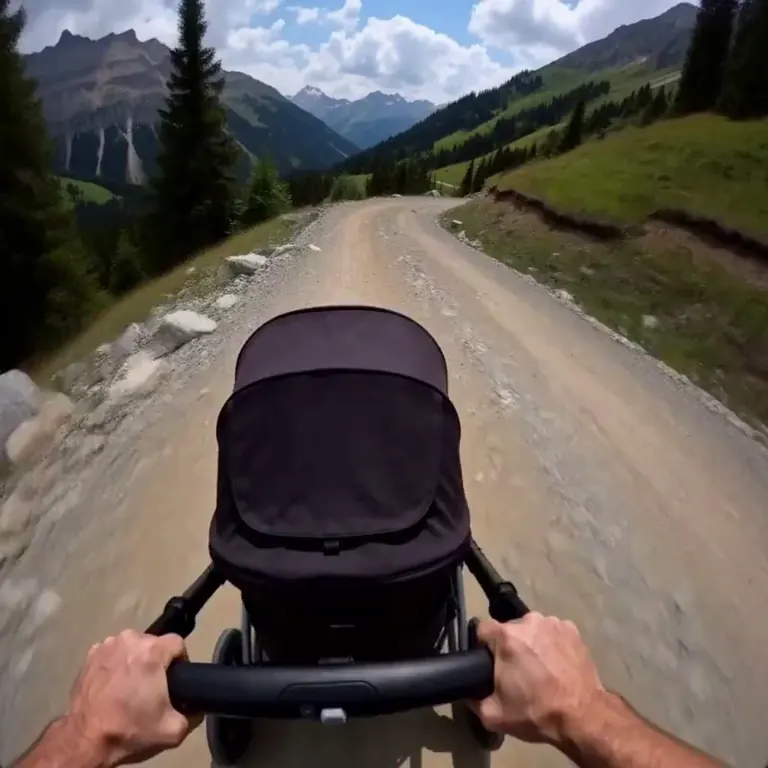
<Subject 1> is the man hands and the stroller shown in <Picture 1>. Preserve the stroller details throughout the video.
summary: [reference generation]
retention_analysis:
<Subject 1> (appears in [Shot 1]): fully_preserved. Maintain the original stroller, materials, colors, and man hands without modifications.
detailed_description:
A continuous first-person POV shot from the man holding the stroller, looking forward along a rugged alpine mountain trail. The stroller races at high speed over an uneven rocky dirt track, surrounded by steep mountain slopes, scattered rocks, and rugged alpine terrain. The vehicle aggressively navigates the trail, with realistic suspension movement and vibrations caused by the rough surface.
The camera remains fixed in the man POV throughout the entire sequence. The dashboard and steering wheel stay consistent with <Picture 1>, while the mountain scenery rushes past outside.
At exactly 10 seconds, the stroller hits a prominent bump in the trail and launches briefly into the air. The forward view rises as the vehicle becomes airborne, with the rocky ground momentarily dropping away beneath the windshield. The car then lands farther down the trail with a strong suspension compression and a noticeable jolt transmitted through the stroller. The vehicle immediately continues racing forward at high speed without stopping, maintaining the same direction and continuous forward momentum.
Camera motion: fixed first-person POV, with natural suspension-induced vertical movement, realistic jolts, and subtle vibration. No cuts, no camera transitions, no external viewpoints.
overall_soundscape:
Loud, realistic engine roar that rises and falls with acceleration. Continuous tire noise over loose gravel and rocks, with stones crunching beneath the wheels and suspension rattling over rough terrain. At the jump, the engine revs as the wheels leave the ground, followed by a brief reduction in tire contact noise. On landing, a heavy suspension thud and sharp mechanical rattle are heard before the tires resume crunching over the rocky trail.
non_diegetic_music: N/A
Setări
Mărime
1792x992
Prompt
subject_definitions:
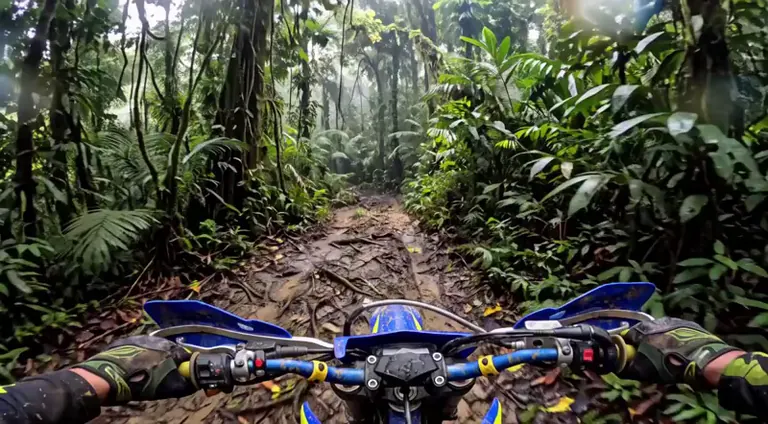
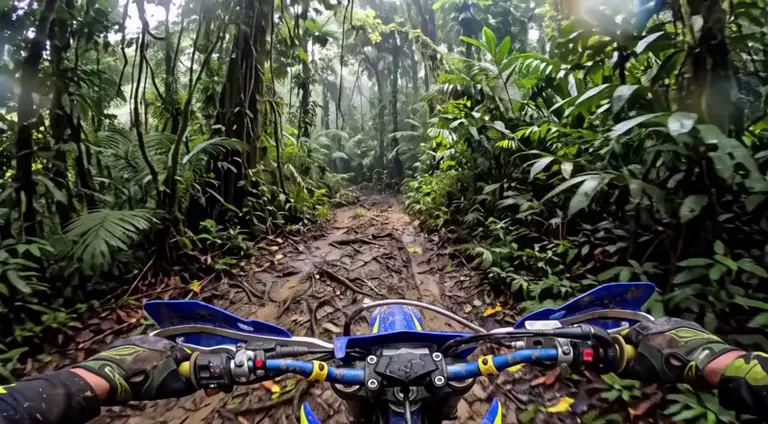
<Subject 1> = the rider's cockpit at the rider's own point of view in <Picture 1>: two hands in black gloves with yellow-green palm and knuckle accents and black wrist cuffs, forearms mud-flecked over black sleeves, gripping a blue cross-braced handlebar; a silver-grey cross brace sitting above a black bar clamp with visible bolts and a small dark instrument display set into it; blue handguards with pale yellow trim carried over brushed aluminium lever arms that arc above each grip; yellow collars sitting at the inner end of each grip against the switchgear; a red-and-grey switch cluster on the left bar and a small red kill switch on the right; black hydraulic lines and cables looping down and back across the bar. Grip spacing, handguard and lever arcs, clamp and display position, cable routing and the blue and yellow plastic tones all derive from <Picture 1>.
<Subject 2> = the blue-and-yellow enduro motorcycle beneath the viewpoint in <Picture 1>: the machine whose motion drives every frame — blue front plastic carrying yellow-and-blue graphics, black fork lowers and front wheel, visible only in the low-mounted and pitching framings at the bottom of frame. It is the same machine each time it enters frame; only how much of it is visible changes.
<Subject 3> = the jungle corridor in <Picture 1>: a narrow muddy single-track with two wet ruts, root crossings, embedded stone, soaked leaf litter and pooled standing water, running away from the camera and bending gently right before it dissolves into canopy haze; flanked on both sides by dense green fronds, broad glossy leaves, thin dark saplings, hanging vines and moss-covered trunks rising out of frame; a bright diffuse sky glow filtering through the canopy upper right with soft haze bloom through the middle distance. Geography, canopy bearing and light direction are preserved from <Picture 1>.
summary:
[reference generation] 8.00 seconds, four hard-cut camera setups (creator-directed multi-cut, deviating from the single-continuous-shot default). A POV enduro rider runs a wet jungle single-track at full throttle — flat out through root and rut, hammering at the bar clamp, banking hard into a right-hander between the trunks, then pitching up a root-cut muddy grade and dropping down the far side.
retention_analysis:
<Picture 1> ([Shot 1] composition anchor / first frame): partially_preserved — retained: <Subject 1>'s cockpit geometry (grip spacing, handguard and lever arcs, cross brace over the clamp, dark display between its bolts, yellow grip collars, switch clusters, cable routing, mud-caked black gloves and sleeves), used in Shots 1, 2 and 4; <Subject 2>'s machine geometry (blue front plastic with yellow graphics, fork lowers, front wheel), used where it enters frame in Shots 2 and 4; <Subject 3>'s world (wet rutted single-track bearing and right-hand bend, root crossings and standing water, frond and broad-leaf flanks, vine and mossed-trunk corridor, canopy haze with diffuse glow upper right), used in all four shots as fixed geography and light. Released per directed setup: framing, mount height, viewing distance, field of view, depth of field and bokeh all change at each hard cut, and pose, lean, pitch and shake are animated rather than frozen. No facial likeness is retained or needed — the rider's face and helmet never enter this point-of-view frame.
detailed_description:
Visual treatment: shaded understorey under one large diffuse source high and slightly camera-right, filtered through the canopy — soft top light, a haze bloom through the upper right of frame, deep green mid-tones and no fill; wet mud holds broad dull speculars and the pooled water in the ruts takes small bright reflections. No vignette, no added lens flare, no arbitrary colour cast. Optics: wide action-camera perspective at the helmet mount with mild edge falloff, narrowing to a tighter arc at the bar-clamp mount; deep focus from roughly 0.4 m into the corridor at the helmet mount so the ruts and roots stay legible, shallower in the low mount where the near lever arm and handguard soften; fine natural sensor grain, no synthetic sharpening. Motion blur is real and forward-vectored — mud, root and leaf streaking radially away from frame centre. Delivery 9:16, crop centred on the bar clamp and the receding track, canopy and haze holding the upper third.
Inherited motion palette — this camera is bolted to the rider and inherits the head, and applies to every setup below: (a) 6–12 Hz chatter of ±1.5–4° yaw and roll from engine and surface aggregate; (b) single-frame 8–15° pitch spikes on root or stone strikes; (c) sustained 20–35° roll banks held through a corner, then released; (d) pitch excursions from −14° nose-down to +22° nose-up under climbing, cresting and dropping; (e) sudden 3–8° yaw corrections as the rider countersteers, with the bar, lever arms and handguards visibly swinging in and out of frame. None of these stops for a cut.
Shot 1 — 00:00.000–00:02.000. Helmet mount, high over the bars; the opening framing matches <Picture 1> exactly at 00:00.000. Both gloved hands and the full bar width across the lower third, blue handguards at the left and right edges, cross brace above the black clamp with its dark display at lower centre, blue front plastic with its yellow graphic below them; the muddy rutted track converging just left of centre and bending right, root crossings and standing water streaking under the bars, dense fronds and broad leaves hard against both frame edges, canopy haze and the bright bloom upper right. Screen direction: forward along the camera z-axis. Motion: relentless forward speed — (a) chatter running continuously at full-throttle rate; at 00:00.700 the front tyre crosses a root — a (b) 9° pitch spike snaps the horizon down and back and throws a fan of mud off the front — then the frame recovers; vines and trunks strobe past both edges; the engine note climbs across the last half second.
HARD CUT — 00:02.000.
Shot 2 — 00:02.000–00:03.800. Bar-clamp mount, low over the triple clamp. Gloved hands now at the extreme left and right frame edges, mud-caked and visible to the wrist cuffs, the black clamp and dark display filling the lower centre, the blue front plastic and yellow graphic entering at the bottom, the track filling the whole frame as a hard field of wet mud, exposed root and embedded stone with the ruts holding standing water. Screen direction: forward along the camera z-axis. Motion: this is the bouncing peak — the frame lives in contact vibration, each root and rut producing a (b) 12–15° vertical jolt with the mud and stone strobing under the wheel and the horizon legible only in fragments between jolts; at 00:03.000 the rear steps out on a slick wet root — the rider makes a (e) 6° yaw snap left, the left lever arm and handguard swinging into frame, mud flicking across the frame plane, the rear re-gripping on the rut edge a hand's width offline. Tyre slurp, mud spray and chain slap are loudest here.
HARD CUT — 00:03.800.
Shot 3 — 00:03.800–00:05.900. Helmet mount, tipped into the right-hand bend. The rutted track curves right between the mossed trunks, so the corridor opens toward the right of frame and the understorey drops away low right; the rider banks the bike into a (c) sustained 28° right roll and holds it through the apex, the horizon rotating counter-clockwise across frame while the canopy swings toward the left edge and the haze bloom slides left with it. Screen direction: forward along the camera z-axis, curvature to the right. Motion: (a) chatter rides on top of the held bank; at 00:04.600 the front washes briefly on wet leaf litter and the rider makes a (e) 5° countersteer snap out of the lean and back in, the bar visibly swinging handguard to handguard; at 00:05.300 the bank releases and the horizon levels as the ground straightens.
HARD CUT — 00:05.900.
Shot 4 — 00:05.900–00:08.000. Helmet mount, driven by the terrain. The line tips up a root-cut muddy grade: a (d) +22° nose-up pitch lifts the upper frame into canopy, hanging vines and bright haze while exposed roots and the rutted climb fill the middle of frame; two root strikes at 00:06.300 and 00:06.600 punch (b) 8–14° pitch spikes through the climb; at 00:06.800 the bike crests and the pitch swings through to (d) −14° nose-down as the front drops into the descent — <Subject 2>'s blue front plastic with its yellow graphic, fork lowers and spinning front wheel enter the bottom of frame for the first time. Screen direction: forward along the camera z-axis, then downward. Motion: on the drop the wheel skips across embedded stone and the rear steps loose on wet leaf litter for one beat before it grips. Final image: the muddy track running away downhill between the trunks into canopy haze, the wheel still spinning and the frame still chattering — nothing settles, the run continues past the last frame.
Continuity locks: Keep unchanged: cockpit geometry, grip spacing, cross brace and clamp position, glove and sleeve state, handguard, lever-arm and grip-collar configuration, machine build and blue plastic tone, wet rutted track bearing and right-hand bend, root crossing and standing-water positions, frond and trunk corridor on both flanks, canopy haze and glow bearing, light direction through the canopy from high camera-right, forward screen direction, gravity physics. Facial likeness is not reproducible — the rider's face and helmet never enter this point-of-view frame.
Exclude: morphing, warping, dissolves, identity drift, geometry warping, invented grass inclines, course markers or plastic stakes, invented alpine gravel or snow skyline, a discovered rider's helmet or face appearing in frame, added lens flares, arbitrary colour casts, unmotivated cuts (the three cut points above are directed and motivated), text overlays, watermark.
No added captions, subtitles, overlays or watermarks.
overall_soundscape:
Enclosed humid jungle air with no long reverb tail — damp, close, foliage-softened. A single-cylinder engine note under load throughout, rising in pitch across Shot 1 and holding near peak through Shots 2 and 3; heavy tyre slurp through wet mud with clods and small stones ticking off the fender and the handguards; standing-water splashes at the ruts in Shot 2; chain slap on the root strikes; brake and lever clack at the correction beats (00:03.000, 00:04.600); broad fronds brushing the mic as they pass the frame edges through Shots 1 and 3. At 00:05.900 the note loads and drops a step as the climb begins, pulls clean over the crest at 00:06.800, then free-spins on the drop. Canopy wind only, high and faint. No dialogue, no voices, no crowd.
non_diegetic_music:
N/A — no score is requested or established for this scene; engine, mud and canopy air carry the rhythmic load.
Setări
Mărime
1024x1024
Prompt
subject_definitions:
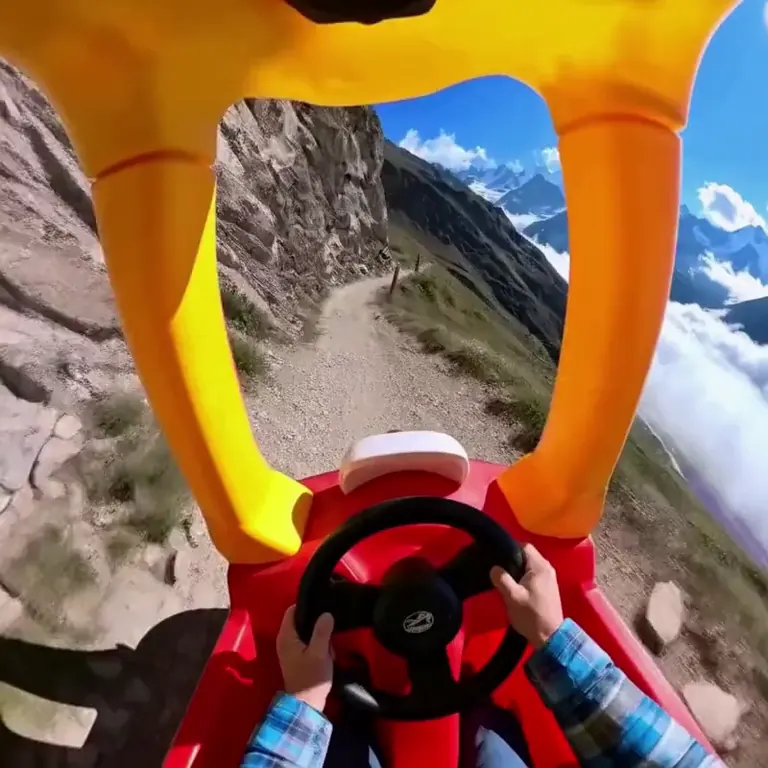
<Subject 1> is the exact car cockpit shown in <Picture 1>. Preserve its original design, dashboard, steering wheel, and interior details throughout the video.
summary: [reference generation]
retention_analysis:
<Subject 1> (appears in [Shot 1]): fully_preserved. Maintain the original cockpit geometry, materials, colors, and layout without modifications.
detailed_description:
A continuous first-person POV shot from the driver's seat of the car, looking forward through the windshield along a rugged alpine mountain trail. The car races at high speed over an uneven rocky dirt track, surrounded by steep mountain slopes, scattered rocks, and rugged alpine terrain. The vehicle aggressively navigates the trail, with realistic suspension movement and subtle cockpit vibrations caused by the rough surface.
The camera remains fixed in the driver's POV throughout the entire sequence. The dashboard and steering wheel stay consistent with <Picture 1>, while the mountain scenery rushes past outside the windshield. The steering wheel reacts naturally to small corrections as the driver maintains control at high speed.
At exactly 10 seconds, the car hits a prominent bump in the trail and launches briefly into the air. The forward view rises as the vehicle becomes airborne, with the rocky ground momentarily dropping away beneath the windshield. The car then lands farther down the trail with a strong suspension compression and a noticeable jolt transmitted through the cockpit. The vehicle immediately continues racing forward at high speed without stopping, maintaining the same direction and continuous forward momentum.
Camera motion: fixed first-person POV, with natural suspension-induced vertical movement, realistic jolts, and subtle vibration. No cuts, no camera transitions, no external viewpoints.
overall_soundscape:
Loud, realistic engine roar that rises and falls with acceleration. Continuous tire noise over loose gravel and rocks, with stones crunching beneath the wheels and suspension rattling over rough terrain. At the jump, the engine revs as the wheels leave the ground, followed by a brief reduction in tire contact noise. On landing, a heavy suspension thud and sharp mechanical rattle are heard before the tires resume crunching over the rocky trail.
non_diegetic_music: N/A
Setări
Mărime
1792x992
Prompt
subject_definitions:
<Subject 1> = the rider's cockpit at the rider's own point of view in <Picture 1>: two hands in black gloves with pale knuckle stitching and black wrist cuffs gripping a red cross-braced handlebar; black handguards with brushed aluminium lever arms arcing over each grip; a red front mask rising above the bar clamp with a dark oval recess and a small pale circular detail on its face; a small dark instrument display set into the clamp between two bright bolts; black hydraulic lines and cables looping down and back from each lever. Grip spacing, handguard and lever arcs, mask and display position, cable routing and the red plastic tone all derive from <Picture 1>.
<Subject 2> = the red enduro motorcycle beneath the viewpoint in <Picture 1>: the machine whose motion drives every frame — red front plastic, black fender edge, fork lowers and front wheel, visible only in the low-mounted and descent framing. It is the same machine each time it enters frame; only how much of it is visible changes.
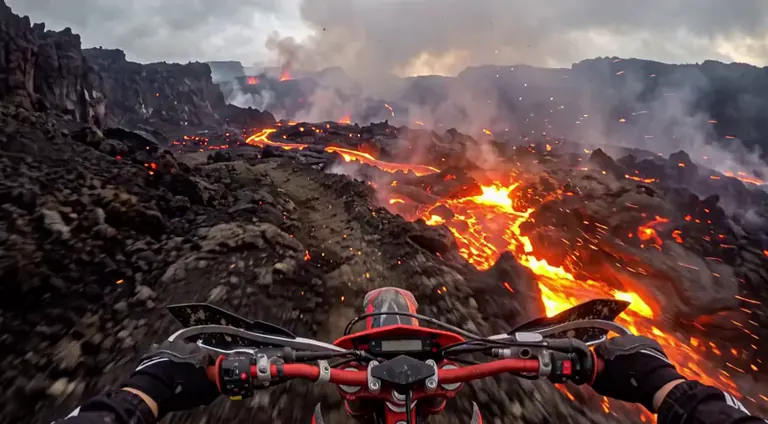
<Subject 3> = the volcanic field in <Picture 1>: black and charcoal basalt cinder and broken lava rock across the left side and the entire foreground; a molten channel of incandescent orange-yellow lava running from mid-left across the middle distance and down toward the lower right, with brighter pooled pockets where the crust breaks; long airborne ember streaks cutting across the right of frame; ash and smoke plumes rising from the field; a dark volcanic ridge line closing the horizon; an overcast grey-white sky above it. Geography, horizon bearing and light direction are preserved from <Picture 1>.
summary:
[reference generation] 8.00 seconds, five hard-cut camera setups (creator-directed multi-cut, deviating from the single-continuous-shot default). A POV enduro rider runs a live lava field at full throttle — flat out across cinder and broken basalt, hammering at the bar clamp, banking hard into a right-hander, pitching up a cinder ridge and plunging down the far side.
retention_analysis:
<Picture 1> ([Shot 1] composition anchor / first frame): partially_preserved — retained: <Subject 1>'s cockpit geometry (grip spacing, handguard and lever arcs, red mask with dark recess, clamp display between its two bolts, cable routing, black wrist cuffs), used in Shots 1, 2 and 5; <Subject 2>'s machine geometry (red front plastic, black fender edge, fork lowers, front wheel), used where it enters frame in Shots 2 and 5; <Subject 3>'s world (black cinder and basalt across the left and foreground, the molten channel bearing from mid-left to lower right, ember streaks on the right, ash plume positions, ridge line bearing, diffuse overcast key from above and behind the terrain, warm emissive bounce from the lava at camera-right), used in all five shots as fixed geography and light. Released per directed setup: framing, mount height, viewing distance, field of view, depth of field and bokeh all change at each hard cut, and pose, lean, pitch and shake are animated rather than frozen. No facial likeness is retained or needed — the rider's face and helmet never enter this point-of-view frame.
detailed_description:
Visual treatment: dim high-altitude overcast daylight under one large diffuse source from above and behind the terrain, flattening the rock into charcoal greys and holding the sky near neutral white without clipping; the only saturated light in frame is emitted by the lava itself — an incandescent orange-yellow bounce rising low from camera-right that throws warm rim light on the lever arms, the underside of the red mask and the inner edges of both gloves. No fill light, no vignette, no added lens flare. Optics: wide action-camera perspective at the helmet mount with mild edge falloff, narrowing to a tighter arc at the bar-clamp mount; deep focus from roughly 0.4 m to the ridge line at the helmet mount so the lava channels stay legible, shallower in the low mount where the near lever arm softens; fine natural sensor grain, no synthetic sharpening. Motion blur is real and forward-vectored — the cinder bed streaking radially away from frame centre. Delivery 9:16, crop centred on the bar clamp and the molten channel, ridge line and smoke holding the upper third.
Inherited motion palette — this camera is bolted to the rider and inherits the head, and applies to every setup below: (a) 6–12 Hz chatter of ±1.5–4° yaw and roll from engine and surface aggregate; (b) single-frame 8–15° pitch spikes on rock or slab strikes; (c) sustained 20–35° roll banks held through a corner, then released; (d) pitch excursions from −16° nose-down to +25° nose-up under climbing, cresting and dropping; (e) sudden 3–8° yaw corrections as the rider countersteers, with the bar and lever arms visibly swinging in and out of frame. None of these stops for a cut.
Shot 1 — 00:00.000–00:01.600. Helmet mount, high over the bars; the opening framing matches <Picture 1> exactly at 00:00.000. Both gloved hands and the full bar width sit in the middle third, the red mask and dark display below the clamp, the black cinder bed raking away from the bottom of frame, the molten channel crossing from mid-left to lower right, ember streaks cutting the smoke on the right, the dark ridge line and ash plumes across the upper third, overcast sky above. Screen direction: forward along the camera z-axis. Motion: (a) chatter running continuously, cinder and broken rock streaking under the bars at full-throttle rate; at 00:00.800 the front tyre crosses a slab edge — a (b) 9° pitch spike snaps the horizon down and back — then the frame recovers; embers sweep past frame right; the engine note climbs across the last half second.
HARD CUT — 00:01.600.
Shot 2 — 00:01.600–00:03.300. Bar-clamp mount, low over the triple clamp. Gloved hands now at the extreme left and right frame edges, the red mask and dark display filling the lower centre, the black fender edge and fork entering at the bottom, the cinder bed filling the whole frame as a hard field of black slag with the molten channel flaring along the right edge. Screen direction: forward along the camera z-axis. Motion: this is the bouncing peak — the frame lives in contact vibration, each rock strike producing a (b) 12–15° vertical jolt with the slag strobing under the wheel and the horizon legible only in fragments between jolts; at 00:02.600 the rider makes a (e) 6° yaw snap left to skirt a raised slab, the left lever arm swinging into frame, the rear stepping a hand's width before it re-grips on cinder. Tyre crunch and chain slap are loudest here.
HARD CUT — 00:03.300.
Shot 3 — 00:03.300–00:04.900. Helmet mount, tipped into the right-hand bend. The usable track curves right between raised basalt walls with the molten channel running along the inside of the corner, so the lava flushes brightest through the right of frame; the rider banks the bike into a (c) sustained 27° right roll and holds it through the apex, the horizon rotating counter-clockwise across frame while the ridge line swings toward the left edge and the ash plume drops low right. Screen direction: forward along the camera z-axis, curvature to the right. Motion: (a) chatter rides on top of the held bank; at 00:04.100 the front washes briefly on loose slag and the rider makes a (e) 5° countersteer snap out of the lean and back in, the bar visibly swinging; at 00:04.700 the bank releases and the horizon levels as the ground straightens.
HARD CUT — 00:04.900.
Shot 4 — 00:04.900–00:06.500. Helmet mount, driven by the terrain. The line tips up a steep cinder ridge: a (d) +24° nose-up pitch fills the upper frame with black ridge grass-less rubble, exposed stone and the overcast sky rolling down toward the top edge; two hard rock strikes at 00:05.500 and 00:05.800 punch (b) 10–14° pitch spikes through the climb; at 00:06.200 the bike crests and the pitch holds a beat before the front goes light. Screen direction: forward along the camera z-axis, then upward.
HARD CUT — 00:06.500.
Shot 5 — 00:06.500–00:08.000. Helmet mount on the plunge. The pitch swings through to (d) −16° nose-down as the front drops off the crest and <Subject 2>'s red front plastic, black fender edge, fork lowers and spinning front wheel enter the bottom of frame for the first time, with the molten channel flaring along the lower right and ember streaks raking past. Screen direction: forward along the camera z-axis, then downward. Motion: the wheel skips across embedded rock; at 00:07.300 the rear steps loose on slag and the rider makes a (e) 7° yaw-and-roll correction that re-grips the line, the bar snapping across frame. Final image: the cinder bed running away downhill between the basalt, the lava channel glowing low right, the wheel still spinning and the frame still chattering — nothing settles, the run continues past the last frame.
Continuity locks: Keep unchanged: cockpit geometry, grip spacing, glove and garment state, machine build and red plastic tone, black cinder bed and molten channel bearing, ridge line and ash plume positions, light direction (diffuse overcast from above and behind, warm emissive bounce from the lava at camera-right), forward screen direction, gravity physics. Facial likeness is not reproducible — the rider's face and helmet never enter this point-of-view frame.
Exclude: morphing, warping, dissolves, identity drift, geometry warping, invented grass, mud or plastic course stakes, a discovered rider's helmet or face appearing in frame, added lens flares, arbitrary colour casts, unmotivated cuts (the four cut points above are directed and motivated), text overlays, watermark.
No added captions, subtitles, overlays or watermarks.
overall_soundscape:
Open air, no reverb, mic mounted with the camera so it takes every jolt. A single-cylinder engine note under load throughout, rising in pitch across Shot 1 and holding near peak through Shots 2 and 3; heavy tyre crunch into cinder and slag with rolling chips underneath; small chips ticking off the fender and the handguards; chain slap on the slab strikes; brake and lever clack at the correction beats (00:02.600, 00:04.100, 00:07.300); steady wind buffeting across the mic capsule that swells on the descent. Under everything, a low continuous volcanic rumble with sparse crackle and pop when the molten channel is closest to frame, from 00:03.300 to 00:04.900. At 00:04.900 the note loads and drops a step as the climb begins, pulls clean over the crest at 00:06.200, then free-spins on the plunge. No dialogue, no voices, no crowd.
non_diegetic_music:
N/A — no score is requested or established for this scene; engine, cinder and the lava field's own low rumble carry the rhythmic load.
Setări
Mărime
1792x992
Prompt
subject_definitions:
<Subject 1> = the rider's cockpit at the rider's own point of view in <Picture 1>: two hands in black gloves with pale knuckle accents and black wrist cuffs gripping a red cross-braced handlebar; black handguards with brushed grey aluminium lever arms arcing over each grip; a dark rounded cowl with a red band sitting above the bar clamp, a small dark instrument display set in the clamp between two bright bolts, and black hydraulic lines and cables looping down and back from each lever. Grip spacing, handguard and lever arcs, cowl and display position, cable routing and red plastic tone all derive from <Picture 1>.
<Subject 2> = the red enduro motorcycle beneath the viewpoint in <Picture 1>: the machine whose motion drives every frame — red front plastic, black front fender edge, fork lowers and front wheel, visible only in the low-mounted and descent framing. It is the same machine each time it enters frame; only how much of it is visible changes.
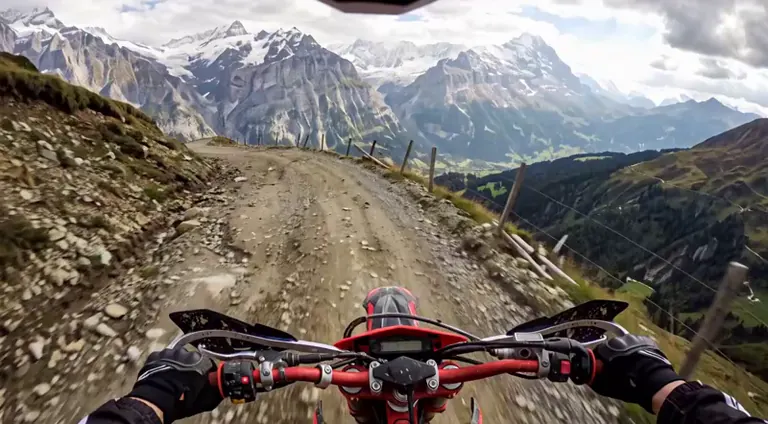
<Subject 3> = the alpine course environment in <Picture 1>: a pale grey-tan gravel double-track with embedded stones and two dark wheel ruts running forward and bending right; a rocky grass bank climbing on the left; a line of weathered wooden posts with slack wire receding downhill along the right edge; a deep green forested valley floor far below to the right; a jagged snow-capped mountain skyline across the upper frame under bright diffuse sky with large white cumulus. Geography, horizon bearing and light direction are preserved from <Picture 1>.
summary:
[reference generation] 8.00 seconds, four hard-cut camera setups (creator-directed multi-cut, deviating from the single-continuous-shot default). A POV enduro rider hammers a high alpine gravel track at full throttle — flat-out over loose stone, hammering at the bar clamp, banking hard into a right-hander, then pitching up a steep grass climb and dropping into a rocky descent.
retention_analysis:
<Picture 1> ([Shot 1] composition anchor / first frame): partially_preserved — retained: <Subject 1>'s cockpit geometry (grip spacing, handguard and lever arcs, cowl and dark display below the clamp, cable routing, black wrist cuffs), used in Shots 1, 2 and 4; <Subject 2>'s machine geometry (red front plastic, black fender edge, fork lowers, front wheel), used where it enters frame in Shots 2 and 4; <Subject 3>'s world (gravel double-track bearing and right-hand bend, rocky grass bank on the left, post-and-wire line descending on the right, forested valley beyond, snow skyline on the same bearing, diffuse high daylight from the upper rear-left), used in all four shots as fixed geography. Released per directed setup: framing, mount height, viewing distance, field of view, depth of field and bokeh all change at each hard cut, and pose, lean, pitch and shake are animated rather than frozen. No facial likeness is retained or needed — the rider's face is never visible in <Picture 1> and never enters frame.
detailed_description:
Visual treatment: bright high-altitude daylight under one large diffuse source from the upper rear-left, so the track reads front-lit, the lever arms and bar clamp take two clean specular hits, and the snow line runs near clipping white with no added haze; no fill light, no vignette, no lens flare. Optics: wide action-camera perspective at the helmet mount with mild edge falloff, narrowing to a tighter arc at the bar-clamp mount; deep focus from roughly 0.4 m to infinity at the helmet mount so the peaks stay legible, shallower in the low mount where the near lever arm softens; fine natural sensor grain, no synthetic sharpening. Delivery is 9:16, crop centred on the bar clamp and the receding track, snow skyline holding the upper fifth.
Inherited motion palette — this camera is bolted to the rider and inherits the head, and applies to every setup below: (a) 6–12 Hz chatter of ±1.5–4° yaw and roll from engine and surface aggregate; (b) single-frame 8–15° pitch spikes on stone or rut strikes; (c) sustained 20–35° roll banks held through a corner, then released; (d) pitch excursions from −15° nose-down to +25° nose-up under braking, climbing and cresting; (e) sudden 3–8° yaw corrections as the rider countersteers, with the bar and lever arms visibly swinging in and out of frame. None of these stops for a cut.
Shot 1 — 00:00.000–00:02.000. Helmet mount, high over the bars; framing matches <Picture 1>. Both gloved hands and the full bar width sit in the middle third, the red cowl and dark display below the clamp, the gravel double-track converging just left of centre, the post-and-wire line receding downhill on the right, the green valley beyond it, the rocky grass bank climbing on the left, the snow skyline across the top fifth. Screen direction: forward along the camera z-axis. Motion: constant full-throttle jitter with (a) running continuously; at 00:00.600 the front tyre strikes a buried stone — the frame pitches down 10° and snaps back, and a stone blur sweeps under the bars; posts strobe past frame right; the horizon stays level; the engine note climbs across the last half second.
HARD CUT — 00:02.000.
Shot 2 — 00:02.000–00:03.800. Bar-clamp mount, low over the triple clamp. Gloved hands now at the extreme left and right frame edges, the red cowl and dark display filling the lower centre, the black front fender edge and fork entering at the bottom, the track filling the whole frame as a hard field of pale stones with two dark ruts. Screen direction: forward along the camera z-axis. Motion: this is the bouncing peak — the frame lives in contact vibration, each rut producing a (b) 12–15° vertical jolt with the stones strobing under the wheel and the horizon legible only in fragments between jolts; at 00:03.300 the rider makes a (e) 6° yaw snap left to skirt a loose stone shelf, the left lever arm swinging into frame, the rear stepping a hand's width before it re-grips on the gravel. Tyre crunch and chain slap are loudest here.
HARD CUT — 00:03.800.
Shot 3 — 00:03.800–00:05.900. Helmet mount, tilted into the right-hand bend. The track curves right around the grass bank; the rider banks the bike into a (c) sustained 26° right roll and holds it through the apex, the horizon rotating counter-clockwise across frame while the snow skyline swings toward the left edge and the valley drops away low right. Screen direction: forward along the camera z-axis, curvature to the right. Motion: (a) chatter rides on top of the held bank; at 00:04.700 the front washes briefly on loose gravel and the rider makes a (e) 5° countersteer snap out of the lean and back in, the bar visibly swinging; at 00:05.400 the bank releases and the horizon levels as the track straightens.
HARD CUT — 00:05.900.
Shot 4 — 00:05.900–00:08.000. Helmet mount, driven by the terrain. The track tips up a steep grass-and-stone climb: a (d) +22° nose-up pitch fills the upper frame with bank grass, exposed stone and the snow peaks rolling down toward the top edge; at 00:06.900 the bike crests and the pitch swings through to −14° nose-down as the front drops into the rocky descent — <Subject 2>'s red front plastic, black fender edge, fork lowers and spinning front wheel enter the bottom of frame for the first time. Screen direction: forward along the camera z-axis, then downward. Motion: two hard stone strikes at 00:06.500 and 00:06.800 punch (b) 8–14° pitch spikes through the climb; on the drop the wheel skips across embedded rock and the rear steps loose for one beat before it grips. Final image: the track runs away downhill between the posts, the wheel still spinning, the frame still chattering — nothing settles, the run continues past the last frame.
Continuity locks: Keep unchanged: cockpit geometry, grip spacing, garment and glove state, machine build and red plastic tone, track bearing and right-hand bend, post-and-wire line position along the right edge, grass bank on the left, valley and snow skyline bearings, light direction from the upper rear-left, forward screen direction, gravity physics. Facial likeness is not reproducible — the face never enters frame.
Exclude: morphing, warping, dissolves, identity drift, geometry warping, a discovered rider's helmet or face appearing in frame, invented mud or course stakes, added lens flares, arbitrary colour casts, unmotivated cuts (the three cut points above are directed and motivated), text overlays, watermark.
No added captions, subtitles, overlays or watermarks.
overall_soundscape:
Open air, no reverb, mic mounted with the camera so it takes every jolt. A single-cylinder engine note under load throughout, rising in pitch across Shot 1 and holding near peak through Shots 2 and 3; heavy tyre crunch and rolling stone on the gravel bed; small stones ticking off the fender and the handguards; chain slap on the rut strikes; brake and lever clack at the correction beats (00:03.300, 00:04.700); steady wind buffeting across the mic capsule that swells on the descent. At 00:05.900 the note loads and drops a step as the climb begins, then pulls clean and free-spinning over the crest at 00:06.900. No dialogue, no voices, no crowd.
non_diegetic_music:
N/A — no score is requested or established for this scene; engine, stone and wind carry the rhythmic load.r
Setări
Mărime
1792x992
Prompt
subject_definitions:
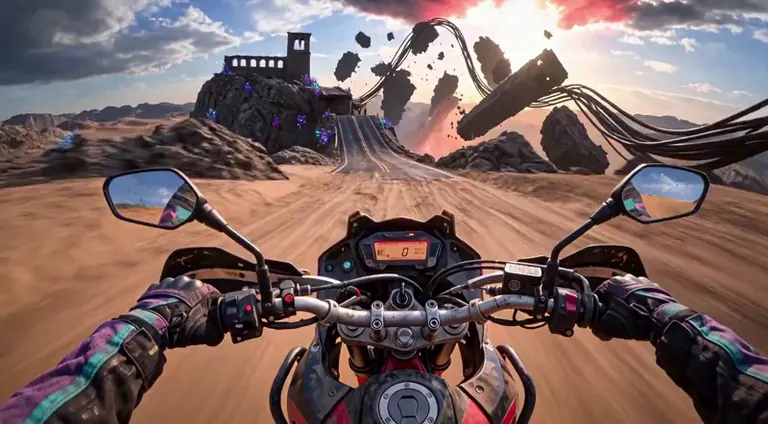
<Subject 1> = the rider's cockpit at the rider's own point of view in image_7.png: two hands in heavily weathered fabric-leather gloves with dirt-patterned purple, cyan, and black paneling, gripping black clip-on bars; a heavily weathered, tarnished metal handlebar with a chunky yoke clamp, textured fasteners, and a black digital dashboard assembly centered below the view; the instrument display is a rectangular digital gauge glowing orange, showing '0' and system bar-graphs; weathered handguards and lever assemblies; switchgear with red and white indicators; clutch and brake assemblies with dirt-crusted hose/cable routing and fluid reservoirs; dual-stalk folding mirrors at the outer edges showing natural mirror-silver and backscatter reflection of the environment; the front fairing and windshield rise slightly ahead, worn and speckled with trail dust. Grip spacing, worn controls, and the machine's distressed color tones all derive from image_7.png.
<Subject 2> = the rugged adventure motorcycle beneath the viewpoint in image_7.png: the machine whose motion drives every frame—faded, dirt-stained red and dark metallic tank shroud, crash bars, and cockpit structural parts visible in the lower third and expanding in low-mounted framing. It is the same machine each time it enters frame; only how much of it is visible changes.
<Subject 3> = the fractured, floating highway and cosmic void in image_7.png: an old, heavily cracked, and fragmented asphalt road with faded double yellow center lines, breaking apart into floating zero-gravity debris; the road bends and curves through a void; to the left, glowing alien bioluminescent flora (purple, blue, and cyan tendrils) grow on jagged dark rock faces and ancient, decaying stone ruins/watchtowers; to the right, a sheer drop into an open, infinite cosmic void filled with levitating rock masses, shattered rubble, and massive, thick dark cable-like or conduit-like structures weaving through space; above and beyond, a violent, swirling dark storm and nebula sky in pinks, purples, and teals, specked with cosmic embers, stars, and dust. Geography, horizon bearing, and light direction are preserved from image_7.png.
summary:
[reference generation] 6.00 seconds, three camera setups, two authored hard cuts at 00:02.200 and 00:04.400. A POV rider on a heavily worn adventure bike races along a crumbling, fragmented floating road over a zero-gravity void, maneuvering through intense vibrations, navigating gaps of floating asphalt, and banking through alien ruins under a cosmic nebula sky, amidst drifting debris and embers.
retention_analysis:image_7.png ([Shot 1] composition anchor / first frame): partially_preserved—retained: <Subject 1>'s cockpit geometry (tarnished metal handlebar, clamp, orange-glowing digital dash, dual mirrors reflecting environment, worn glove patterns), used in Shots 1, 2, and 3; <Subject 2>'s machine geometry (dirty red and dark tank shroud, crash bars), used in Shots 1 and 2; <Subject 3>'s world (fractured asphalt road with double yellow lines, crumbling edges, glowing alien flora on the left, ancient watchtowers, floating rock masses and dark cable-like structures, violent pink-purple-teal nebula, drifting cosmic embers, diffuse ambient key from the nebula), used in all three shots as fixed geography and light. Released per directed setup: framing, mount height, viewing distance, field of view, depth of field, and bokeh change at each hard cut, and pose, lean, pitch, yaw, and shake are animated rather than frozen. Facial likeness is not retained or needed—the rider's face and helmet never enter this point-of-view frame. Unsupported element flag: the zero-gravity debris, levitating ruins, and cable-like structures are evidenced by the attachment but are not approved canon; if not confirmed by the creator, they are atmosphere only, and the path, the bike, and the camera motion carry the scene.
detailed_description:
Visual treatment: atmospheric cosmic and bioluminescent lighting from the swirling nebula and glowing purple-blue alien plants, holding the rugged trail in deep shadowed grays and worn asphalt tones while glowing purple/cyan bioluminescence provides organic highlights; wet-free but highly distressed, dusty asphalt with scattered loose debris and crumbling edges. Saturated accents include the bike's faint red tones, the orange digital dash, and the vivid pink-purple nebula, which cast a faint, flickering color bounce on the dusty windshield and the rider's gloves. No fill light, no vignette, no added lens flare, no arbitrary color cast. Optics: wide, shaky action-camera perspective at the helmet mount with mild edge distortion, narrowing to a tighter, lower-mounted perspective at the handlebars/yoke mount; deep focus from roughly 0.4 m to the middle distance so the trail, the ruins, and the cosmic nebula stay legible, shallower in Shot 2 where the shaking near elements soften; fine natural sensor grain with motion blur that is real, forward-vectored, and streaking radially with scattered embers. Delivery 16:9, crop centered on the handlebars and the winding road, with the giant alien structures, cable-like conduits, and nebula holding the upper third.
INHERITED MOTION PALETTE—this camera is bolted to the rider and inherits the head, and applies to every setup below: (a) 6–12 Hz chatter of plus or minus 2–4 degrees of yaw and roll from the rough, fractured asphalt and engine vibration; (b) single-frame 8–15 degree pitch spikes on debris, gaps, and ruts; (c) a sustained 20–30 degree bank held through natural curves and maneuvers, with the horizon counter-rotating against the bike roll; (d) pitch excursions from minus 15 to plus 10 degrees over the disintegrating trail; (e) sudden 4–8 degree countersteer snaps as the rider fights loose debris and gaps; (f) 6–12 degree brake dive as the forks compress; (i) 1–2 cycles of compression and rebound hop after hard strikes. Head counter-rotation applies: on any sustained bank, the horizon rotates less than the bike angle. No element in this palette stops at a cut.
[Shot 1] — 00:00.000–00:02.200. Helmet mount, high over the handlebars; the opening framing matches image_7.png exactly at 00:00.000. Both gloved hands on the grips, the weathered yoke and orange dash centered, with the dusty windshield and mirrors at the edges, the fractured asphalt road bending slightly right ahead before winding past the giant structures, the glowing alien flora on the left, and the vast void with pulsing pink/teal nebula and dark cable-like structures. Screen direction: forward along the camera z-axis. Motion: (a) heavy chatter running continuously at speed, loose stone and debris streaking under the wheel; at 00:01.400, a (b) 12-degree pitch spike from striking a crumbling asphalt edge snaps the horizon down and back, followed by (i) a rapid compression-rebound oscillation as the rider fights to maintain control; the rider makes an (e) 5-degree countersteer snap to keep the machine on the path, the handlebars and guards visibly jolting.
HARD CUT — 00:02.200.
[Shot 2] — 00:02.200–00:04.400. Low handlebar/yoke mount, closer to the machine's red-and-silver nose. The gloved hands are at the extreme left and right, with the rugged yoke, and vibrating instruments dominating the lower third. The rough, fragmented asphalt fills the frame as a hard, shaking field, with rock walls and glowing purple plants raking past on the left and the deep, spark-filled cosmic void on the right. Screen direction: forward along the camera z-axis. Motion: intense vibration and bouncing; each piece of loose debris produces a (b) 10–14 degree vertical jolt with the dirt and sparks strobing; at 00:03.200, the machine experiences (g) a rear step-out on loose gravel, yawing 5 degrees as the note rises before the tyre grips again and the rider corrects.
HARD CUT — 00:04.400.
[Shot 3] — 00:04.400–00:06.000. Helmet mount, high over the handlebars. Tipped into a gentle left-hand curve as the path winds under ancient, crumbling stone ruins, with levitating rocks and cosmic nebula filling the sky. Screen direction: forward with a slight left-bearing. Motion: the rider banks the bike into a (c) sustained 24-degree left roll, holding it as they pass under the shadow of the crumbling structures, with the horizon counter-rotating; (a) heavy chatter remains layered over the bank; at 00:05.200, the front (f) dips under an 8-degree brake dive as the rider adjusts to avoid falling debris, the handlebars and windshield dropping and the horizon shifting, before releasing and leveling toward the path ahead. Final image: the bike hurtling forward on the disintegrating road, embers and debris flying, with the cosmic nebula and cable-like structures still dominating the sky—the run continues past the final frame.
Continuity locks:
Keep unchanged: cockpit geometry, grip spacing, clamp and yoke hardware, handguards, orange digital display, glove and sleeve state, machine build and dirty red/metallic tone, path features and debris-laden surface, left-side cliff with bioluminescent flora and ruins, right-side open void with levitating masses and cable-like structures, storm ceiling and cosmic nebula, light direction (diffuse and flickering from the right and above), forward screen direction, gravity physics. Facial likeness is not reproducible—the rider’s face and helmet never enter this point-of-view frame. The numeric dash readout is not a locked data value.
Exclude:
morphing, warping, dissolves, identity drift, geometry warping, ordinary asphalt roads, sand, or lava (this is fractured floating road terrain), invented course markers, a discovered rider’s helmet or face appearing in frame, added lens flares, arbitrary color casts, unmotivated cuts (the two cut points are directed and motivated), text overlays, watermark.
No added captions, subtitles, overlays or watermarks.
overall_soundscape:
Deep, cosmic void air with a chaotic, echo-distorted return—the camera mic takes every violent bounce and rush of wind. Heavy, roaring engine note under load throughout, screaming and revving as the rider fights for traction, with a brief pitch rise at 00:03.200; loud crunching, scraping, and loose stone impact over fracturing asphalt, with small debris and gravel ticking off the skid plate and handguards; persistent wind and airborne buffeting that swells and whips around the camera; brake/lever clack on corrections (00:01.400, 00:05.200); a deep, low-frequency atmospheric rumble and pulsing hum from the canyon’s cable-like structures and the churning cosmic nebula above, with distant crumbling or crashing sounds. No dialogue, no voices, no crowd.
non_diegetic_music:
N/A—no score is requested or established; engine, shattering earth, and cosmic void atmosphere carry the rhythmic load.
Nu a fost partajat niciun prompt cu această randare.
Setări
Mărime
1792x992
Prompt
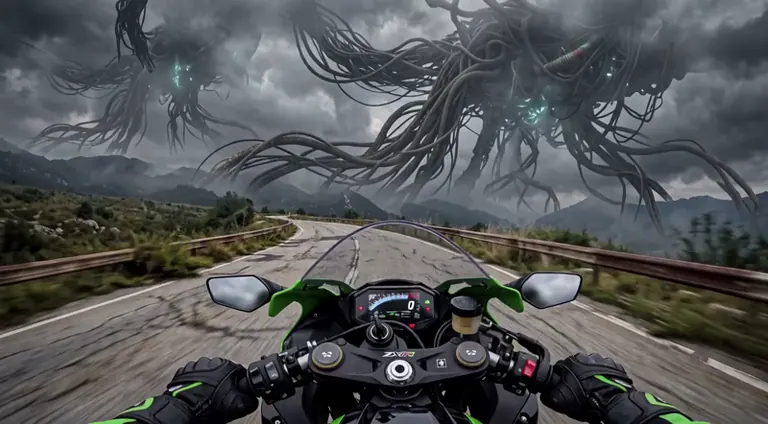
subject_definitions:
<Subject 1> = the rider's cockpit at the rider's own point of view in <Picture 1>: two hands in black leather gloves carrying bright green knuckle, palm-edge and cuff accents, gripping black clip-on bars; black grips and black switchgear clusters with green-outlined buttons on the left and a red kill switch on the right; a black upper yoke carrying a large chrome steering-stem nut, two black fork-top adjusters with pale engraved markings, a small translucent fluid reservoir with a black cap on the right, and ZX10R lettering across the yoke face; a black-tinted windshield arcing above; two folding mirrors on black stalks at the left and right frame edges with green fairing winglets beneath them; a rectangular digital instrument display centred above the yoke showing a bar-graph tachometer with a large numeric readout and green, white and red elements. Grip spacing, control layout, mirror and winglet placement, yoke hardware and the machine's green plastic tone all derive from <Picture 1>. The numeric readout is visible but is not treated as a locked data value.
<Subject 2> = the green-and-black sport motorcycle beneath the viewpoint in <Picture 1>: the machine whose motion drives every frame — bright green upper fairing shoulders and winglets flanking the black dash surround, a black-tinted screen, black bar and yoke hardware, visible in the opening framing and again in the low-mounted framing at the bottom of frame. It is the same machine each time it enters frame; only how much of it is visible changes.
<Subject 3> = the mountain road and storm world in <Picture 1>: cracked, patched and sun-bleached asphalt with coarse aggregate, a dark centre seam and a long running crack, a worn white edge line low left, running away from the camera and bending gently right in the middle distance before it passes out of frame; weathered rust-brown W-beam guardrails on both sides on short posts; scrub, coarse grass and low green brush on both shoulders rising into wooded green slopes and layered misted ridges toward the horizon; a heavy dark grey-green storm ceiling above it all; and two colossal tendrilled masses hanging in the sky — a smaller mass at frame left and a much larger one occupying the centre and right, built of thick grey-green rope-like strands with faint pale cyan luminescent pockets deep inside them. Geography, horizon bearing and light direction are preserved from <Picture 1>.
summary:
[reference generation] 5.00 seconds, three camera setups, two authored hard cuts at 00:01.700 and 00:03.300. A POV rider runs a cracked mountain road at speed between rusted guardrails under a storm ceiling, the colossal tendrilled mass hanging over the bend — flat out over the centre seam, hammering through the yoke mount, then banking right toward the misted ridge.
retention_analysis:
<Picture 1> ([Shot 1] composition anchor / first frame): partially_preserved — retained: <Subject 1>'s cockpit geometry (grip spacing, clip-on and yoke hardware, chrome stem nut, fork-top adjusters, fluid reservoir, mirror stalks, green winglets, display surround), used in Shots 1, 2 and 3; <Subject 2>'s machine geometry (green fairing shoulders and winglets, black screen, black bar and yoke), used in Shots 1 and 2; <Subject 3>'s world (cracked asphalt with centre seam and running crack, worn edge line, rust guardrail line and post spacing on both sides, shoulder scrub, wooded slopes and misted ridge bearing, storm ceiling, both tendril mass bearings and their altitude relative to the bend, faint cyan luminescence at the right mass, diffuse overcast key from above and slightly camera-left), used in all three shots as fixed geography and light. Released per directed setup: framing, mount height, viewing distance, field of view, depth of field and bokeh change at each hard cut, and pose, lean, pitch, yaw and shake are animated rather than frozen. Facial likeness is not retained or needed — the rider's face and helmet never enter this point-of-view frame. Unsupported element flag: the storm ceiling and the two tendrilled masses are evidenced by the attachment but are not approved canon; if they are not confirmed by the creator they are atmosphere only, and the road, the machine and the light carry the scene.
detailed_description:
Visual treatment: flat storm daylight from one broad source above and slightly camera-left, holding the tarmac in mid greys and the slopes in muted green while the cloud ceiling stays dark without clipping; wet-free dry asphalt with a dull even sheen, rust bloom on the guardrail faces, and no specular highlight anywhere on the road. The only saturated accents in frame are the machine's green plastic and glove trim, and the faint pale cyan luminescence deep inside the tendril mass at frame right, which throws no bounce onto the machine. No fill light, no vignette, no added lens flare, no arbitrary colour cast. Optics: wide action-camera perspective at the helmet mount with mild edge falloff, narrowing to a tighter arc at the yoke mount; deep focus from roughly 0.4 m to the bend at the helmet mount so the road, the guardrail line and the tendril mass stay legible, shallower at the yoke mount where the near mirror stalk and switchgear soften; fine natural sensor grain, no synthetic sharpening. Motion blur is real and forward-vectored — asphalt grain, edge line and guardrail posts streaking radially away from frame centre. Delivery 9:16, crop centred on the yoke and the road axis, the tendril mass and storm ceiling holding the upper third.
INHERITED MOTION PALETTE — this camera is bolted to the rider and inherits the head, and applies to every setup below: (a) 7–12 Hz chatter of plus or minus 1.5–3 degrees of yaw and roll from engine and asphalt aggregate; (b) single-frame 8–12 degree pitch spikes on the centre seam, patch edges and the running crack; (c) a sustained 18–24 degree bank held through the right-hand bend, then released; (d) pitch excursions from minus 12 to plus 8 degrees over the patched crown; (e) sudden 3–6 degree countersteer snaps with the bar, levers and mirrors visibly swinging in and out of frame; (f) 6–10 degree brake dive with the yoke and mirrors dropping together when the rider corrects line; (g) a rear step of about a hand's width across the polished aggregate and edge-line paint, with a short re-grip. Head counter-rotation applies: on the bank the horizon rotates less than the bike angle. None of these stops for a cut.
[Shot 1] — 00:00.000–00:01.700. Helmet mount, high over the bars; the opening framing matches <Picture 1> exactly at 00:00.000. Both gloved hands and the full bar width across the lower third, the digital display and yoke hardware centred, the mirrors and green winglets at the left and right frame edges, the black screen arcing above them, the cracked road converging just left of centre and bending right in the middle distance, the worn edge line low left, the rust guardrails running to the bend on both sides, shoulder scrub and wooded slopes beyond them, the storm ceiling and the two tendrilled masses filling the upper half with the larger mass centre-right. Screen direction: forward along the camera z-axis. Motion: (a) chatter running continuously at speed, asphalt grain and the centre seam streaking under the bars; at 00:01.100 the front crosses the long running crack — a (b) 9 degree pitch spike snaps the horizon down and back and jolts the treeline and both mirrors together — then the frame recovers; the machine's green shoulders hold steady against the rotating ground; the note climbs across the last half second.
HARD CUT — 00:01.700.
[Shot 2] — 00:01.700–00:03.300. Yoke mount, low over the top clamp. Gloved hands now at the extreme left and right frame edges, the black yoke and chrome stem nut filling the lower centre with the fork-top adjusters and the small fluid reservoir, the green fairing shoulders entering at both lower corners, the cracked tarmac filling the whole frame as a hard running field with the edge line raking left and the guardrail above it. Screen direction: forward along the camera z-axis. Motion: this is the bouncing peak — each patch seam produces a (b) 12–15 degree vertical jolt with the asphalt strobing under the wheel and the horizon legible only in fragments between jolts; at 00:02.300 the rider makes an (e) 5 degree countersteer snap left to skirt a broken patch edge, the left switchgear and mirror swinging into frame, the rear stepping a hand's width on the polished aggregate and paint before it re-grips. Tyre roar and drivetrain are loudest here.
HARD CUT — 00:03.300.
[Shot 3] — 00:03.300–00:05.000. Helmet mount, tipped into the right-hand bend. The road curves right toward the misted ridge with the guardrail turning with it, the larger tendril mass dominating the upper right and the smaller mass holding upper left; the rider banks the machine into a (c) sustained 22 degree right roll and holds it through the apex while the rider's head counter-rotates against that roll, so the horizon lags roughly half the bike angle and the storm ceiling rotates counter-clockwise across frame. Screen direction: forward along the camera z-axis, curvature to the right. Motion: (a) chatter rides on top of the held bank; at 00:04.400 the front settles under a (f) 9 degree brake dive as the rider corrects line, the yoke and mirrors dropping together and the green shoulders dipping a hand's width in frame; at 00:04.800 the bank releases and the horizon levels as the road straightens toward the mist. Final image: the road running away toward the ridge between the guardrails, the tendril mass still hanging over the centre of frame, the frame still chattering — nothing settles, the run continues past the last frame.
Continuity locks: Keep unchanged: cockpit geometry, grip spacing, clip-on and yoke hardware, mirror and winglet placement, glove and garment state, machine build and green plastic tone, cracked road bearing and curvature, centre seam and running-crack positions, edge-line position, guardrail line and post spacing, shoulder scrub and ridge bearing, both tendril mass bearings and altitude, storm ceiling, light direction (broad overcast key from above and slightly camera-left), forward screen direction, gravity physics. Facial likeness is not reproducible — the rider's face and helmet never enter this point-of-view frame. The numeric dash readout is not a locked data value.
Exclude: morphing, warping, dissolves, identity drift, geometry warping, invented enduro terrain, cinder, lava or jungle foliage, invented course markers or plastic stakes, extra tendrils beyond the two established masses, any tendril reaching the road or the machine, any creature intent or attack invented, a discovered rider's helmet or face appearing in frame, added lens flares, arbitrary colour casts, unmotivated cuts (the two cut points above are directed and motivated), text overlays, watermark.
No added captions, subtitles, overlays or watermarks.
overall_soundscape:
Open mountain air with a long soft return off the valley — the mic is mounted with the camera and takes every jolt. Engine note under load throughout, rising across Shot 1 and holding near peak through Shots 2 and 3; broad continuous tyre roar over coarse asphalt with grit rolling under the guards; small stones ticking off the fairing lower and the fork; a faint drivetrain whine; brake and lever clack at the correction beats (00:02.300, 00:04.400); steady wind buffeting across the capsule that swells through the bend; behind everything a low continuous storm wind layer with two distant thunder rolls, one under Shot 1 and one under Shot 3. No sound is attributed to the tendrilled masses. No dialogue, no voices, no crowd.
non_diegetic_music:
N/A — no score is requested or established for this scene; engine, asphalt and the storm air carry the rhythmic load.
Rulează local
Cum să instalezi

Cum să instalezi un LoRA: foldere, verificări de fișiere și prima utilizare în ComfyUI, Forge, Automatic1111 și Draw Things
24 Sep 2025
extremeEnduroBetterBike_v1.safetensors
Descărcările sunt servite de Civitai. Unii creatori cer mai întâi autentificarea pe Civitai.



Extreme Enduro Better Bike POVs and Motion este un LoRA pentru familia MiniMax H3, listat pe ModelTrends.ai, un catalog doar pentru citire al modelelor AI open source pentru imagini, video și text. Compară-l cu alte modele MiniMax H3, verifică-i scorul de căldură pentru a vedea cât este de popular și deschide-l pe PirateDiffusion sau BitVector pentru a-l încerca.
Mai multe modele MiniMax H3Mai multe LoRA MiniMax H3videoacțiunifotografiepovacțiunebikespeedmișcare
Răsfoiește după familia de modele

Modele Text / LLM
434

Modele Anima
528

Modele Chroma
19
Modele Fibo
2

Modele Flux
1,496
Modele Flux 2 / Klein
1,239

Modele Flux 3
3

Modele Moss
3

Modele Iris
1

Modele MiniMax H3
364

Modele Hunyuan
204

Modele Ideogram
20

Modele Krea2
717

Modele Qwen
20
Modele Qwen2
47
Modele Ltx2
153